


| Teen flash mob theft in Arizona is usually charged as shoplifting, organized retail theft, or robbery, depending on what each teen did and whether force was used. Because the group acted together, one teen can be held responsible for items others took. Most cases start in juvenile court, but serious charges can move to adult court. Call a criminal defense attorney before your teen speaks to police. |
Reviewed by Joshua A. Lopez, Esq., criminal defense attorney licensed in Arizona, California, and Nevada; J.D. cum laude, California Western School of Law (2016). Founder of The Law Office of Joshua A. Lopez, LLC, Scottsdale, Arizona. Last legally reviewed October 2026.
Teen flash mob theft happens when a group of young people rushes into a store together, grabs merchandise, and runs out before employees can react. Arizona does not have a single “flash mob” statute, so prosecutors build these cases from several existing laws, and the charge your teen faces can range from a misdemeanor to a serious felony. If police have contacted, cited, or arrested your child after a group theft, the choices you make in the first few days can shape whether the case stays in juvenile court and how it ends.
What Counts as a Flash Mob Theft?
A flash mob theft, sometimes called a flash rob, is a coordinated group theft. The plan is often organized through group chats or social media, and the strategy relies on numbers: when 10, 20, or 30 people enter at once, store staff cannot stop everyone. Many participants are teenagers who join because friends are going, sometimes without understanding that the plan involves stealing until they are already inside.
That last point matters. Arizona law focuses on what each person knew, intended, and did. A teen who walked in expecting a prank and left empty-handed is in a very different legal position than a teen who planned the event, carried a bag to hide merchandise, or pushed an employee out of the way.
Why the Group Makes the Charges More Serious
The group element is what turns a typical shoplifting case into something prosecutors take far more seriously. Under Arizona’s accomplice liability law, A.R.S. 13-303, a person can be held criminally responsible for another person’s conduct if they intended to promote or facilitate the offense and helped plan it, encouraged it, or aided it. In practice, that means prosecutors may try to hold every participant responsible for the total value of everything the group took, not just what one teen carried out.
Group conduct can also trigger enhancements written into the theft statutes themselves. Arizona’s shoplifting law treats thefts that are part of a continuing criminal episode, or that are done to assist a criminal street gang or criminal syndicate, as felonies regardless of the dollar amount.
Arizona Charges Teens May Face After a Flash Mob Theft
The exact charge depends on the facts. Here are the offenses that most often appear in Arizona group theft cases.
Shoplifting (A.R.S. 13-1805)
Shoplifting merchandise worth less than $1,000 is a class 1 misdemeanor. Property worth $1,000 to just under $2,000 is a class 6 felony, and $2,000 or more is a class 5 felony. The charge rises to a class 4 felony when the person uses an artifice, container, or device to help conceal or remove goods, such as a foil-lined bag, or has two or more qualifying theft-related offenses within the past five years.
Organized Retail Theft (A.R.S. 13-1819)
Organized retail theft is a class 4 felony. A person commits it by removing merchandise without paying with the intent to resell or trade it, or by using a device or container to help remove the merchandise. Prosecutors often reach for this charge in flash mob cases because the planning and group coordination look like an organized effort. Proving intent to resell, however, takes real evidence, and that is often where a defense begins.
Robbery and Aggravated Robbery (A.R.S. 13-1902 and 13-1903)
If anyone in the group uses or threatens force against an employee or shopper while taking property or escaping, the case can become a robbery, which is a class 4 felony. When the person is aided by one or more accomplices who are actually present, Arizona classifies the offense as aggravated robbery, a class 3 felony. Because flash mob thefts involve a group by definition, any physical contact with store staff can quickly push the case into this category.
Burglary, Trafficking, and Related Charges
Depending on the facts, prosecutors may add charges such as burglary, criminal damage, trespassing, or trafficking in stolen property. Burglary charges are more likely when a store was closed, when entry was forced, or when a teen had already been banned from the property. Trafficking charges can follow if the state believes the teen sold or offered the stolen goods for sale online afterward.
Can a Teen Be Charged as an Adult for Flash Mob Theft?
Most teen flash mob cases are handled in juvenile court, where the focus is on rehabilitation, restitution, and supervision rather than prison. However, A.R.S. 13-501 gives the county attorney discretion to file charges in adult court against a teen who was at least 14 at the time of the offense when the accusation involves a class 1 or class 2 felony, a dangerous offense, certain class 3 felonies, or a teen who qualifies as a chronic felony offender. An aggravated robbery allegation arising from a flash mob can open that door.
This is why early legal involvement matters so much. Prosecutors often make the charging decision before a family fully understands what is happening, and a defense attorney can present facts about your teen’s role, school record, and home life before prosecutors commit to a path.
Comparing the Likely Charges
| Charge | Statute | Common Flash Mob Trigger | Classification |
| Shoplifting, under $1,000 | A.R.S. 13-1805 | Teen took a small amount with no device and no prior record | Class 1 misdemeanor |
| Shoplifting, $1,000 to $1,999 | A.R.S. 13-1805 | Value of items crosses the felony line | Class 6 felony |
| Shoplifting, $2,000+ or continuing episode | A.R.S. 13-1805 | Group total aggregated, or repeat thefts in a short period | Class 5 felony |
| Shoplifting with a device | A.R.S. 13-1805 | Lined bag or tool used to conceal or remove goods | Class 4 felony |
| Organized retail theft | A.R.S. 13-1819 | Evidence of plan to resell, or device used | Class 4 felony |
| Robbery | A.R.S. 13-1902 | Force or threat against an employee or shopper | Class 4 felony |
| Aggravated robbery | A.R.S. 13-1903 | Robbery with accomplices actually present | Class 3 felony |
What the Penalties Look Like
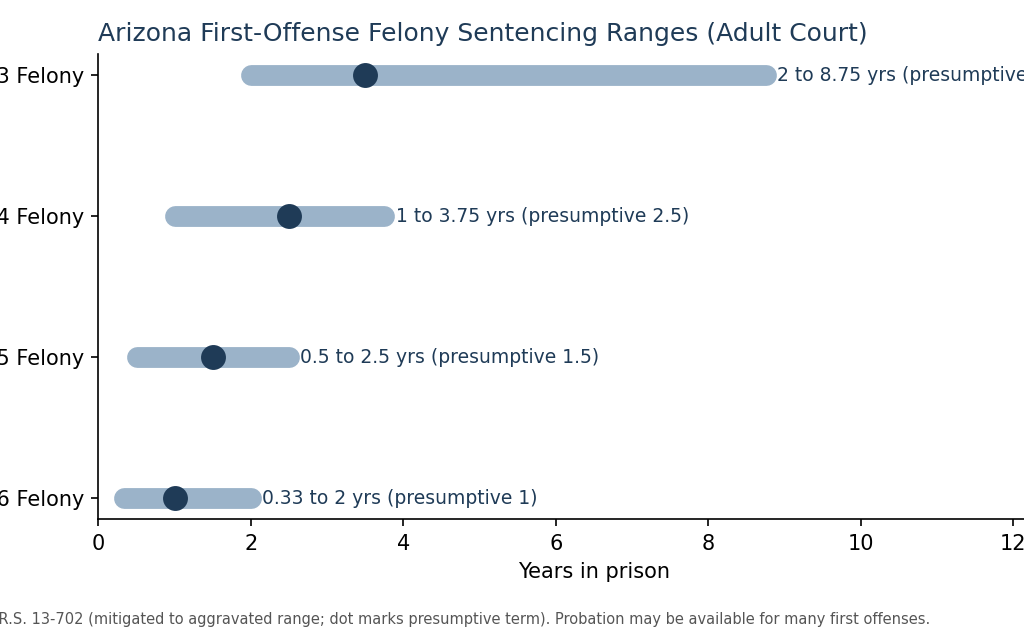
In juvenile court, outcomes can include diversion, probation, community service, counseling, restitution to the store, and in serious cases, commitment to the Arizona Department of Juvenile Corrections. If a teen is prosecuted as an adult, Arizona’s felony sentencing ranges apply. The chart below shows first-offense prison ranges in adult court. Probation is available for many first-time offenses, but not all.
Local Data: How Group Theft Cases Unfold in Scottsdale
Scottsdale has seen firsthand how group theft cases develop after the fact. Following the looting at Scottsdale Fashion Square on May 30, 2020, Scottsdale police continued making arrests for weeks. KTAR News reported that the total reached 44 people charged, with suspects identified through video and physical evidence collected at the scene. Minors were among those arrested, facing charges that included burglary, theft, trafficking in stolen property, and possession of stolen property.
The lesson for parents is that the absence of an arrest on the day of an incident does not mean the matter is over. Investigators review surveillance footage, social media, and tips, and a knock on the door can come weeks later.
Defenses in Teen Flash Mob Theft Cases
Every case turns on its facts, but these are some of the defenses an experienced Scottsdale criminal defense attorney will look at closely.
- Mere presence. Being in the store when others stole is not a crime by itself. The state must prove your teen intended to promote or help the theft.
- Misidentification. Flash mob footage is often chaotic, low resolution, and full of teens in similar clothing. Identifications based on that video can be challenged.
- Valuation. The dollar amount drives the charge level. Prosecutors sometimes aggregate the group’s total, and that number can be disputed.
- Intent to resell. Organized retail theft requires proof of intent to resell or trade, or use of a device. Without that evidence, the charge may be reduced.
- Rights violations. Police questioning of minors raises serious constitutional issues. Statements obtained without proper warnings or under coercive conditions may be suppressed.
| WORRIED YOUR TEEN COULD BE CHARGED AS AN ADULT?
Attorney Josh personally handles every case and gives clients his contact information on day one, so you are never left waiting for answers while charging decisions are being made. “Attorney Joshua Lopez truly cares, and can do the job!” Client review, FindLaw Call (480) 630-0799 for a free consultation. |
But My Child Only Took One Item
Many parents assume a single shirt or pair of shoes means a minor citation. Sometimes that is true. But because of accomplice liability and the continuing criminal episode rule, the state may try to tie your teen to the full value of everything the group took. If any participant touched an employee, the case may be framed as aggravated robbery. The item in your child’s hands is only one part of the picture, and a defense attorney can push back on efforts to stretch the charge beyond what your teen actually did.
Parents Can Face Financial Consequences Too
Arizona juvenile courts can order restitution for the losses a teen caused, and parents of unemancipated minors can face civil liability to merchants under state law. Stores frequently send civil demand letters soon after an incident. Before you pay anything or sign anything, speak with an attorney, because what you say in response can affect the criminal case.
What Parents Should Do Right Now
- Do not let your teen speak with police, store loss prevention, or school officials about the incident until you have talked to a lawyer.
- Ask your teen not to post, delete, or message anyone about what happened. Deleting content can create new problems.
- Write down what your teen tells you, including who organized the event and how they heard about it.
- Keep any citation, letter, or paperwork you receive.
- Contact a criminal defense attorney who handles juvenile cases in Maricopa County.
Frequently Asked Questions About Teen Flash Mob Theft
Can my teenager be charged as an adult for a flash mob theft in Arizona?
Most teen flash mob cases stay in juvenile court. However, under A.R.S. 13-501, a county attorney may file adult charges against a teen who was at least 14 if the accusation is a class 1 or class 2 felony, a dangerous offense, or certain class 3 felonies, which can include aggravated robbery when force is used with accomplices present.
What if my child did not take anything during the flash mob?
Being present is not the same as being guilty. To hold a teen responsible for what others took, the state generally must show the teen intended to promote or help the theft under Arizona accomplice law. Running into a store with a group, acting as a lookout, or blocking an employee can be used as evidence of that intent, so the details matter.
Is flash mob theft a felony in Arizona?
It can be. Shoplifting under $1,000 is usually a class 1 misdemeanor, but the same conduct can become a felony if it is part of a continuing criminal episode, involves a device such as a lined bag, is done with intent to resell, or involves force against an employee.
Can parents be held financially responsible for a teen flash mob theft?
Yes. Arizona juvenile courts can order restitution, and merchants have civil remedies under state law that can reach the parents of an unemancipated minor. A store may also send a civil demand letter. Talk to a defense attorney before paying or responding.
How do police identify teens after a flash mob theft?
Police commonly rely on store surveillance video, social media posts and messages used to organize the event, phone location data, and tips from people who recognize faces in released footage. Arrests can happen days or weeks after the incident.
Will a juvenile flash mob theft charge stay on my child’s record forever?
Not necessarily. Arizona allows many juvenile records to be destroyed once the person meets the statutory requirements, and diversion can keep some cases from resulting in a formal adjudication. Adult convictions are harder to clear, which is one reason keeping the case in juvenile court matters so much.
What Happens When You Call
When you call (480) 630-0799, you speak directly with Attorney Josh or his office, not a call center. He will ask what your teen is accused of, whether police have made contact, and whether any court dates or letters have arrived. The consultation is free. You will leave the call understanding the likely charges, whether adult court is a realistic risk, and what should happen next to protect your child.
Related Resources
Families dealing with group theft accusations often have questions that overlap with other charges. Learn more about how our Scottsdale criminal defense attorney handles serious cases, how juvenile crime defense in Arizona differs from adult court, what to expect with shoplifting charges in Arizona, and how prosecutors approach theft crimes and organized retail theft.
Talk to a Scottsdale Defense Attorney About Your Teen’s Case
A flash mob theft accusation can follow a teenager for years if it is handled poorly, and the most important decisions often happen before the first court date. Attorney Joshua A. Lopez is licensed in Arizona, California, and Nevada, and he personally handles each case from start to finish. Clients describe him as hardworking and responsive, and one wrote that he “came through for us during a very difficult time.”
Call The Law Office of Joshua A. Lopez, LLC at (480) 630-0799 for a free, confidential consultation. 6991 E. Camelback Road, Suite D-300, Scottsdale, AZ 85251.