


| An Arizona MVD implied consent hearing decides whether your license will be suspended for 12 months after refusing a DUI test. An administrative law judge considers only four issues: reasonable grounds, arrest, refusal, and whether you were warned. You must request the hearing within 30 days of the notice, and a timely request keeps you driving until the decision. Talk to a DUI attorney before the deadline passes. |
Reviewed by Joshua A. Lopez, Esq., criminal defense attorney licensed in Arizona, California, and Nevada; J.D. cum laude, California Western School of Law (2016). Founder of The Law Office of Joshua A. Lopez, LLC, Scottsdale, Arizona. Last legally reviewed October 2026.
An Arizona MVD implied consent hearing is a short administrative proceeding that decides one question: should your driver’s license be suspended because you refused a breath, blood, or urine test after a DUI arrest? It is separate from your criminal DUI case; it has its own deadline, and it can be won. Understanding what happens at the hearing, and what the judge can and cannot consider, is the first step to protecting your license.
Why a DUI Refusal Starts Two Separate Cases
Every Arizona driver agrees to chemical testing under A.R.S. 28-1321, the state’s implied consent law. When a driver arrested for DUI refuses a test, or fails to expressly agree to and complete it, the refusal triggers two tracks at once.
- The criminal case is handled in court and decides whether you are guilty of DUI.
- The MVD case is handled by the Arizona Department of Transportation and decides only whether your driving privilege is suspended.
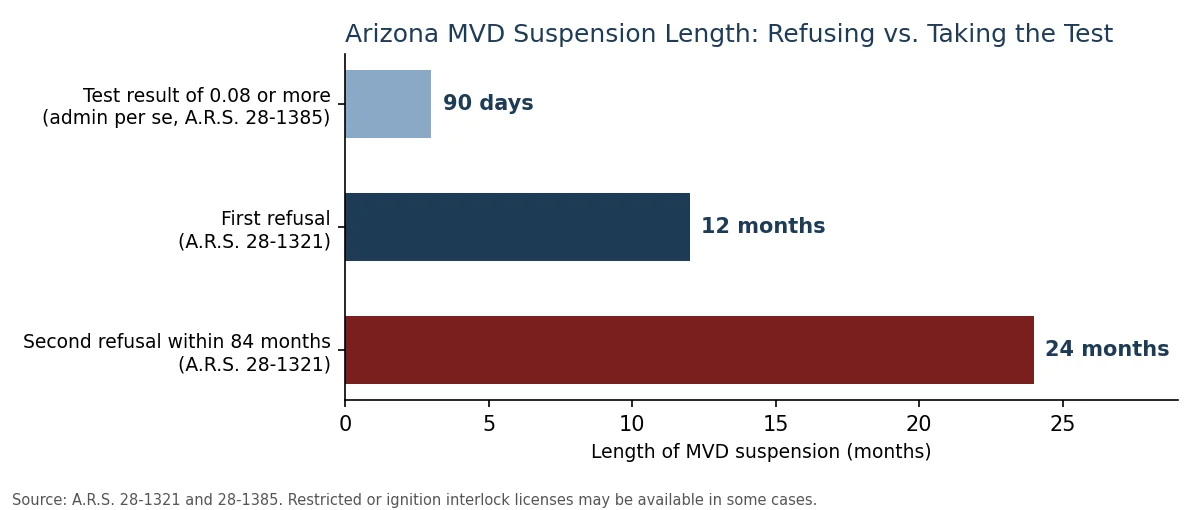
A first refusal carries a 12-month suspension. A second refusal within 84 months carries a two-year suspension. Those penalties apply even if the DUI charge is later reduced or dismissed, which is why the MVD case deserves its own attention.
The 30-Day Deadline to Request a Hearing
After a refusal, the officer usually serves an order of suspension, takes your Arizona license, and gives you a temporary permit valid for 30 days. In some cases, the officer instead tells you the MVD will mail the notice. Either way, the suspension takes effect 30 days after the notice unless you act.
To stop it, the MVD must receive your written or online hearing request within 30 days of the notice date. To accept the request, you generally must have surrendered your license or certify that it was lost or destroyed. A timely request stays the suspension until the hearing, so you can keep driving on temporary permits while the case is pending.
Miss the deadline and the suspension becomes final. There is no hearing and no chance to challenge the officer’s account.
What Happens at the Hearing
Once the MVD receives your request, it must schedule the hearing within 60 days. An administrative law judge conducts hearings, which may be held in person, by telephone, or by videoconference. They are far less formal than a courtroom trial, and most last well under an hour.
A typical implied consent hearing follows this order:
- The judge opens the record and identifies the exhibits, including the officer’s certified refusal report.
- The arresting officer testifies under oath about the stop, the arrest, and the refusal.
- Your attorney cross-examines the officer and may present video, records, or your own testimony.
- Both sides make brief closing arguments, and the judge issues a written decision.
The officer’s certified report is signed under penalty of perjury, but the officer’s live testimony often matters more. Inconsistencies between the report, body camera footage, and the officer’s answers under questioning often determine the outcome.
The Only Four Issues the Judge Can Decide
Arizona law limits the scope of an implied consent hearing. Under A.R.S. 28-1321(K), the judge may consider only the following questions.
| Issue | What the State Must Show | Common Challenges |
|---|---|---|
| Reasonable grounds | The officer had reasonable grounds to believe you were driving or in actual physical control while impaired | Weak or missing signs of impairment, no proof you were driving, problems with field sobriety tests |
| Arrest | You were placed under arrest before the test was requested | Test requested before a lawful arrest occurred |
| Refusal | You refused, or failed to expressly agree and complete the test | Confusion, a request to speak with a lawyer, medical inability to complete a breath test |
| Warning | You were told your license would be suspended for refusing | Incomplete or inaccurate admonition, language barriers |
Arguments outside these four issues, such as whether you were actually impaired or whether the traffic stop was fair in a general sense, are generally not part of the decision. A strong hearing strategy focuses on facts within these limits.
What Happens After the Judge Decides
If the Suspension Is Sustained
The suspension takes effect 30 days after written notice. Before your license can be reinstated, you must complete alcohol or drug screening. For a first refusal that involved alcohol only, you may qualify for a special ignition interlock restricted driver license after screening, which lets you drive a vehicle equipped with an interlock device for the rest of the suspension.
You also have the right to appeal. You can file a petition for review in superior court within 30 days after the suspension is sustained, and the court must hear it on an expedited basis.
If the Suspension Is Not Sustained
Your license is not suspended for the refusal. Arizona law also provides that a ruling in your favor is not admissible in, and does not affect, any other administrative, civil, or criminal case.
Why the Hearing Helps Your Criminal Case Too
Even when the odds at the MVD are stacked against you, the hearing still has value. It is often the first time the arresting officer answers questions under oath, long before a criminal trial. That testimony can lock in the officer’s account, reveal gaps in the investigation, and support later motions in the DUI case.
There is one important tradeoff. Arizona law allows the MVD to issue an ignition interlock restricted license early, but accepting it waives your right to a hearing on the suspension. That choice should be made with an attorney who understands both cases.
| REFUSED A DUI TEST IN SCOTTSDALE OR PHOENIX?
The 30-day hearing deadline starts running the day you receive the notice. Attorney Josh personally handles every DUI case and gives clients his direct contact information on day one. “Attorney Joshua Lopez truly cares, and can do the job!” Client review, FindLaw Call (480) 386-1824 for a free consultation. |
Local Data: DUI Enforcement in Arizona
DUI enforcement in the Phoenix area is constant and intensifies around holidays. According to Arizona Governor’s Office of Highway Safety figures reported by KTAR, officers made 385 DUI arrests statewide over the 2025 Labor Day weekend, and Scottsdale ranked among the top five agencies for DUI arrests so far that year. KVOA reported that the 2025 holiday season task force produced 1,084 DUI arrests statewide. Every one of those arrests that involved a refusal started a 30-day clock on an MVD hearing request.
Frequently Asked Questions About Arizona Implied Consent Hearings
How long do I have to request an implied consent hearing in Arizona?
The MVD must receive your written or online request within 30 days after the date of the notice of suspension. If the request is late, the 12-month suspension becomes final and you lose the chance to contest it at a hearing.
Will I lose my license before the MVD hearing?
Not if you request the hearing on time. A timely request stays the suspension until the hearing is held, and the MVD can issue temporary permits that remain valid until it makes a final decision.
Do I have to attend the MVD hearing in person?
Not necessarily. Arizona law allows the MVD to hold implied consent hearings in person, by telephone, or by videoconference. Your attorney can appear with you and handle the officer’s questioning.
Can I win the MVD hearing if the police got a warrant and took my blood anyway?
Possibly. A blood draw under a search warrant does not erase a refusal for suspension purposes. The hearing still focuses on whether the officer had reasonable grounds, whether you were arrested, whether you actually refused, and whether you were properly warned.
Does winning the MVD hearing get my DUI charge dismissed?
No. The MVD hearing only decides the license suspension. However, if the suspension is not sustained, you cannot use the ruling against you in any other proceeding, and the officer’s sworn testimony at the hearing can help your defense in the criminal case.
Can I get a restricted license after refusing a DUI test in Arizona?
For a first refusal involving alcohol only, you may be able to apply for a special ignition interlock restricted driver license after completing alcohol screening. Accepting that license early can waive your right to an MVD hearing, so talk to an attorney before applying.
What Happens When You Call
When you call (480) 386-1824, you speak with Attorney Josh or his office, not a call center. He will ask when you were arrested, whether you received an order of suspension, and whether you requested a hearing. The consultation is free. You will leave the call knowing your exact deadline, whether a hearing makes sense in your situation, and what to do next to protect your license and your case.
Related Resources
A refusal is only one part of a DUI case. Learn more about how our Scottsdale DUI defense attorney handles the criminal side, what penalties apply under Arizona DUI laws, and how a Scottsdale criminal defense attorney approaches serious charges.
Protect Your License Before the Deadline Passes
An implied consent hearing is one of the few chances you have to challenge a refusal suspension, and it disappears 30 days after the notice. Attorney Joshua A. Lopez represents drivers throughout Scottsdale, Phoenix, and the rest of Maricopa County in both MVD hearings and DUI court cases. One client wrote that he “came through for us during a very difficult time.”
Call The Law Office of Joshua A. Lopez, LLC at (480) 386-1824 for a free, confidential consultation. 6991 E. Camelback Road, Suite D-300, Scottsdale, AZ 85251.